
NAVIGATING CARBON TRADING IN INDONESIA

Daniel Tampi
Managing Partner
daniel.tampi@clavislawfirm.id

Oliviani Yanto
Associate
oliviani.yanto@clavislawfirm.id
As countries step up their efforts to tackle climate change, carbon trading has become an important mechanism for incentivising businesses to reduce greenhouse gas (“GHG”) emissions. By allowing the purchase and sale of carbon units, carbon trading creates economic incentives for emissions reductions and supports the achievement of climate targets, complementing conventional regulatory measures.
Indonesia has also taken significant steps to strengthen its carbon market as part of its commitment to achieving its Nationally Determined Contribution (“NDC“), which sets out its targets for reducing GHG emissions under the Paris Agreement. To support these commitments, the Government has introduced Presidential Regulation No. 110 of 2025, which is further regulated through several implementing regulations, including Minister of Environment Regulation No. 10 of 2026 on the Carbon Unit Registry System and Financial Services Authority (Otoritas Jasa Keuangan or “OJK”) Regulation No. 14 of 2023 on Carbon Trading through the Carbon Exchange, as amended by OJK Regulation No. 10 of 2026.
What should businesses know about Indonesia’s carbon trading framework? The following sections provide an overview of the framework, from its basic concepts to how it operates in practice.
Carbon Trading, Emissions Trading, and Carbon Offsetting: What Is the Difference?
Carbon trading, emissions trading, and carbon offsetting are closely related, but conceptually, they are not the same. Each serves a different purpose within Indonesia’s carbon trading framework.
Carbon trading refers to the buying and selling of carbon units. It is built on several economic and environmental principles, including the cap-and-trade principle and the polluter-pays principle. The cap-and-trade principle sets a limit on emissions and allows businesses to trade emission allowances, while the polluter-pays principle requires businesses to bear the costs associated with the environmental harm caused by their emissions. These principles encourage businesses to manage emissions responsibly and reduce overall emissions.
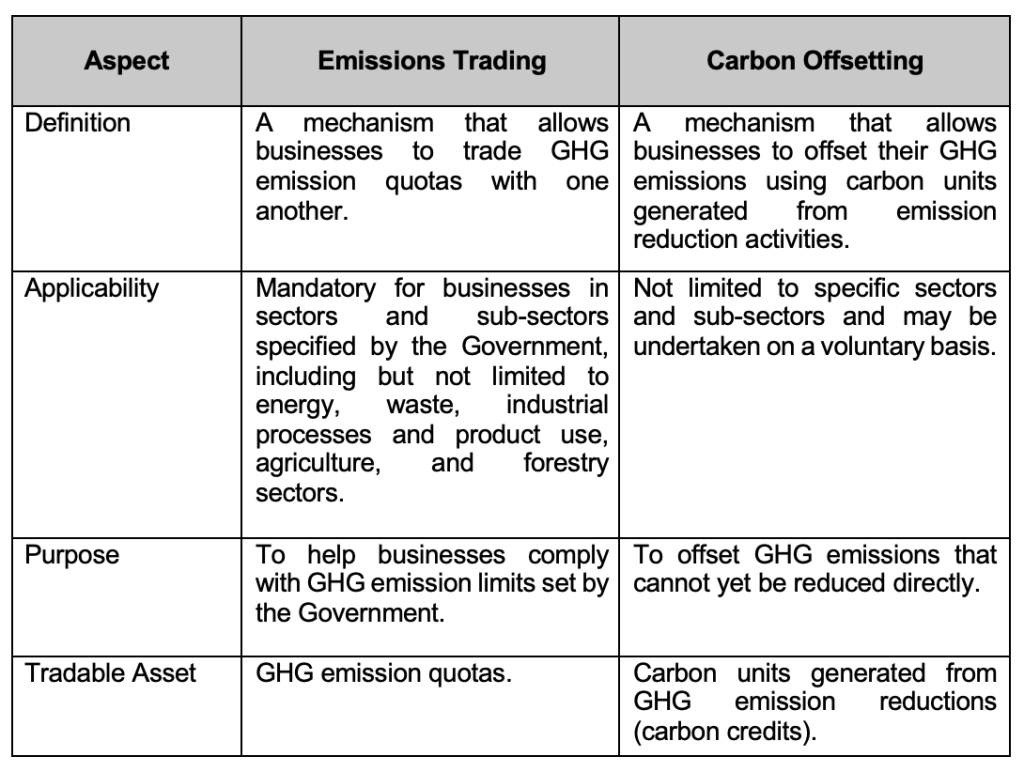
Indonesia’s carbon trading regulatory framework provides two (2) schemes: (a) emission trading, which applies to businesses and activities within mandatory sectors and sub-sectors; and (b) carbon offsetting, which allows businesses to voluntarily participate in carbon trading.
The key differences between the two (2) schemes are set out below:
How Is Carbon Trading Carried Out?
Carbon trading can be carried out through the following arrangements:
- Domestic carbon trading, which is conducted between carbon market participants in Indonesia. Domestic carbon trading can take place through:
-
- emissions trading, where businesses must first receive their allocated GHG emission quota. Businesses must take climate change mitigation actions to ensure that total emissions generated during one (1) year do not exceed the allocated GHG emission quota. If total emissions exceed the allocated GHG emission quota, businesses must either purchase GHG emission quotas, purchase GHG emission offsets, or pay a carbon tax.
- carbon offsetting, where businesses offset their emissions by paying for emission reductions from activities elsewhere.
-
- International carbon trading, which involves parties from outside Indonesia. These transactions may require authorization from the Minister of Environment to use carbon units for international purposes. Another requirement is a corresponding adjustment to prevent the same emission reduction from being counted twice when carbon units are transferred abroad.
The applicable requirements depend on how the carbon units are used:-
- authorization and corresponding adjustment required when carbon units are used to meet an NDC or other international obligations; and
- no authorization or corresponding adjustment required when carbon units are not used to meet an NDC or other international obligations.
-
Where Are Carbon Units Traded?
Before carbon units can be traded, they must first be registered in the Carbon Unit Registry System (Sistem Registri Unit Karbon or “SRUK”) and may be recorded in the records maintained by the carbon exchange operator.
Carbon trading transactions can be conducted in two (2) types of transactions:
-
Direct or private transaction, where carbon units are traded directly between the relevant parties, such as the project developer or carbon unit owner and the buyer;
- Secondary market, where carbon units are traded through a carbon exchange that records carbon trading transactions and tracks ownership of carbon units. In Indonesia, the carbon exchange is currently operated by IDXCarbon.
Each carbon trading transaction must also be recorded in the SRUK and on the carbon exchange. The recorded information includes the identities of the parties, the unique code and amount of carbon units traded, and documents evidencing the transfer.
What Type of Carbon Units Can Be Traded?
There are three (3) types of carbon units that can be traded:
- GHG Emission Quotas
GHG emission quotas are emission limits allocated to certain businesses. A business can trade any unused emission quotas to another business that needs additional quotas.
- GHG Emission Reduction Certificates (Sertifikat Pengurangan Emisi or “SPE GHG”)
An SPE GHG is a certificate evidencing GHG emission reductions achieved through an activity or business. It is issued after the emission reduction has been measured, reported, and verified through the measurement, reporting, and verification process. SPE GHGs must be registered at SRUK in the form of registry code and are traded through the GHG emissions offsetting mechanism. These certificates can be used to trade carbon units, compensate for GHG emissions, support climate change mitigation activities, and demonstrate a business’s sustainability efforts, including those financed through bonds.
- Non-SPE GHG
Non-SPE GHG refers to carbon units other than SPE GHG that are issued based on international standards and approved by the relevant minister.
How Are SPE GHG and Non-SPE GHG Issued?
The process of issuing carbon units depends on the type of unit:
- SPE GHG
To obtain an SPE GHG, a business must first prepare a Climate Change Mitigation Action Plan Document (Dokumen Rancangan Aksi Mitigasi Perubahan Iklim or “DRAM”). The business must then complete the following steps:
-
- register the relevant business or activity in the SRUK;
- have the GHG emission reduction verified by an independent verifier; and
- submit the verification results to the Minister of Environment or relevant authority, which forms the basis for the recommendation to issue the SPE GHG.
An SPE GHG cannot be issued from unused GHG emission quotas.
-
- Non-SPE GHG
To obtain a Non-SPE GHG, a business must prepare a Project Planning Document (Dokumen Perencanaan Proyek or “DPP”). Non-SPE GHGs are issued under an international certification scheme after obtaining approval from the relevant minister.
In addition, the DRAM and DPP contain similar information about the proposed mitigation action, applicable methodologies and standards, environmental and sustainable development impacts, public consultation, and supporting data.
The continued development of Indonesia’s carbon market may create new opportunities for businesses to participate in carbon trading while supporting the country’s climate goals. Understanding the applicable mechanisms and requirements can help businesses identify how carbon trading may be relevant to their activities.
If you have any questions about carbon trading in Indonesia or how the framework may apply to your business, please feel free to contact our team.
Disclaimer
This publication is prepared by Clavis Law Firm for general informational purposes only and does not constitute legal advice. It is intended to provide a high-level overview of the relevant legal and regulatory developments as of the date of publication and should not be relied upon as a substitute for specific legal advice.