
CHANGES TO THE IMPLEMENTATION OF GOVERNMENT PROCUREMENT IN INDONESIA

Daniel Tampi
Managing Partner
daniel.tampi@clavislawfirm.id

Oliviani Yanto
Associate
oliviani.yanto@clavislawfirm.id
Government procurement creates opportunities for companies to supply goods, carry out construction projects, and provide consulting and other services. The rules behind these opportunities shape how companies take part in the procurement process, from selecting the right procurement method to meeting the applicable requirements.
The Government Procurement Policy Agency (Lembaga Kebijakan Pengadaan Barang/Jasa Pemerintah or “LKPP”) has issued Regulation No. 3 of 2026 on Guidelines for the Preparation and Implementation of Government Procurement of Goods/Services Through Providers (“LKPP Regulation 3/2026”). It replaces LKPP Regulation No. 12 of 2021 on Guidelines for the Implementation of Government Procurement of Goods/Services through Providers, as amended by LKPP Regulation No. 4 of 2024 (“LKPP Regulation 12/2021”).
This article highlights the key changes introduced by LKPP Regulation 3/2026 and the practical implications for companies involved in government procurement.
Procurement Methods
LKPP Regulation 12/2021 and LKPP Regulation 3/2026 sets out the same five (5) procurement methods, covering e-purchasing, direct procurement (pengadaan langsung), direct appointment (penunjukan langsung), quick tender (tender cepat), and tender/selection (tender/seleksi). However, LKPP Regulation 3/2026 expressly clarifies that limited tender (tender terbatas) can also be used to accelerate development in Papua.
These five (5) methods involve different procurement processes:
- e-purchasing involves purchasing goods and/or services through an electronic catalogue;
- direct procurement allows the procuring party to purchase goods, other services, or construction work directly from a provider, subject to the applicable value limits;
- direct appointment allows a provider to be appointed directly in specific circumstances permitted by the regulations;
- quick tender involves selecting a provider through an electronic process based on the applicable qualifications and criteria; and
- tender/selection involves selecting a provider through a competitive process, with tenders generally used for goods, construction work, and other services, and selection used for consulting services.
Regarding quick tender, LKPP Regulation 12/2021 limited eligibility to business entities qualified in the Provider Performance Information System (Sistem Informasi Kinerja Penyedia or “SIKaP”). LKPP Regulation 3/2026 broadens the eligibility criteria by allowing quick tender to be used for business entities that meet the qualification criteria specified for the relevant procurement package.
Mandatory E-Purchasing
LKPP Regulation 12/2021 provided that a tender was used when e-purchasing, direct procurement, direct appointment, and quick tender could not be used. In contrast, LKPP Regulation 3/2026 requires e-purchasing for the selection of providers of goods, other services, and non-construction consulting services listed in the electronic catalogue.
However, this requirement is subject to two (2) exceptions: (a) when the listed products or services cannot meet the required volume, technical specifications, timing, location, or service needs; or (b) when another procurement method is considered more efficient or effective. The applicability of these exceptions is assessed by the Commitment-Making Official (Pejabat Pembuat Komitmen or “PPK”).
Owner’s Estimate
Previously, LKPP Regulation 12/2021 required the Owner’s Estimate (Harga Perkiraan Sendiri or “HPS”) to be determined no later than 28 working days before the proposal submission deadline. This time limit has been removed under LKPP Regulation 3/2026, which provides that HPS determination takes place shortly before the provider selection preparation stage.
Another change concerns the HPS thresholds for direct procurement and direct appointment of construction works by Procurement Officials. LKPP Regulation 12/2021 set the HPS threshold for both direct procurement and direct appointment at Rp200 million. Meanwhile, LKPP Regulation 3/2026 retains the HPS threshold for direct appointment at Rp200 million and increases the HPS threshold for direct procurement to Rp400 million.
Repeat Orders
LKPP Regulation 12/2021 limited repeat orders to construction consulting services and allowed them to be issued no more than twice in consecutive fiscal years. LKPP Regulation 3/2026 expands the scope of repeat orders to construction works, non-construction consulting services, and goods and other services, provided that the initial work was awarded through a tender or selection process.
Repeat orders may be issued no more than twice within three (3) years from the date of the final handover certificate for the initial work. In addition, the provider must have an overall performance rating of at least “Good” and a “Very Good” rating for the initial work. For repeat-order packages involving goods and other services, the HPS must not exceed the final contract value of the initial work.
Electronic Procurement Systems
Procurement through providers was carried out through the electronic procurement system and its supporting systems, as stated in LKPP Regulation 12/2021. This requirement is further specified in LKPP Regulation 3/2026, which requires these systems to include transactional or recording features.
The transactional feature facilitates all stages of the provider selection process. It is used for:
- direct procurement of goods, construction works, and other services valued at more than Rp50 million;
- direct procurement of consulting services;
- direct appointment;
- quick tender;
- tender/selection; and
- limited tender to accelerate development in Papua.
On the other hand, the recording feature is available for direct procurement of goods, construction works, and other services valued at up to Rp50 million.
If the PPK or the official who is responsible for signing the contract determines the transactional feature ineffective or inefficient, the recording feature can also be used for direct procurement valued at more than Rp50 million involving individual providers of other services that support public services (such as cleaning staff, landscaping staff, and other field workers). Furthermore, the government internal supervisory apparatus must review the use of recording feature before the provider selection process starts.
Prioritizing Domestic Products
When reviewing the availability of goods and services, the PPK must consider the Domestic Component Level (Tingkat Komponen Dalam Negeri or “TKDN”) based on the list of goods and services produced in Indonesia. Under LKPP Regulation 12/2021, foreign products were disqualified during bid evaluation upon the availability of products with a combined TKDN and Company Benefit Weight (Bobot Manfaat Perusahaan or “BMP”) value of at least 40%. This rule applied only to procurement packages involving a single type of good.
The approach to domestic products is further clarified in LKPP Regulation 3/2026, which introduces a priority order for considering domestic products before imported products. This priority order is illustrated below, with each subsequent level applying when products at the preceding level are unavailable or insufficient in volume:
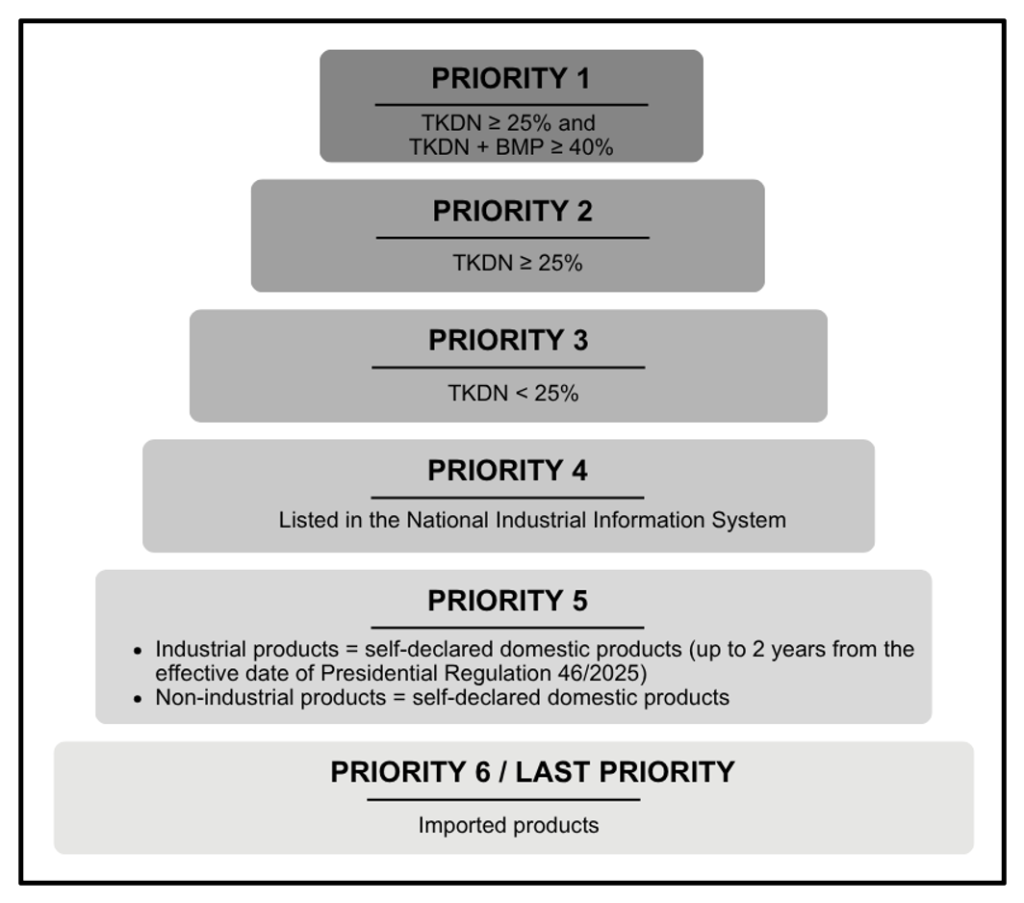
Each priority level is explained as follows:
- Top priority is given to domestic products with a TKDN of at least 25% and a combined TKDN and BMP value of at least 40%;
- If products under point (a) are unavailable or insufficient in volume, domestic products with a TKDN of at least 25% must be used;
- In the absence of sufficient products under points (a) and (b), domestic products with a TKDN of less than 25% must be used;
- Where products under points (a) to (c) are unavailable or insufficient in volume, domestic products listed in the National Industrial Information System must be used.
- If none of the products under points (a) to (d) are available in sufficient quantities, industrial products declared as domestic through the self-declare mechanism may be used for up to two (2) years from the effective date of the Presidential Regulation No. 46 of 2025 on the Second Amendment to Presidential Regulation No. 16 of 2018 on Government Procurement of Goods/Services (“Presidential Regulation 46/2025”). For non-industrial products, the domestic product requirement is fulfilled by using products declared as domestic through the self-declare mechanism; or
- Imported products may be used if none of the domestic products under points (a) to (e) are available in sufficient quantities.
Construction Business Classification
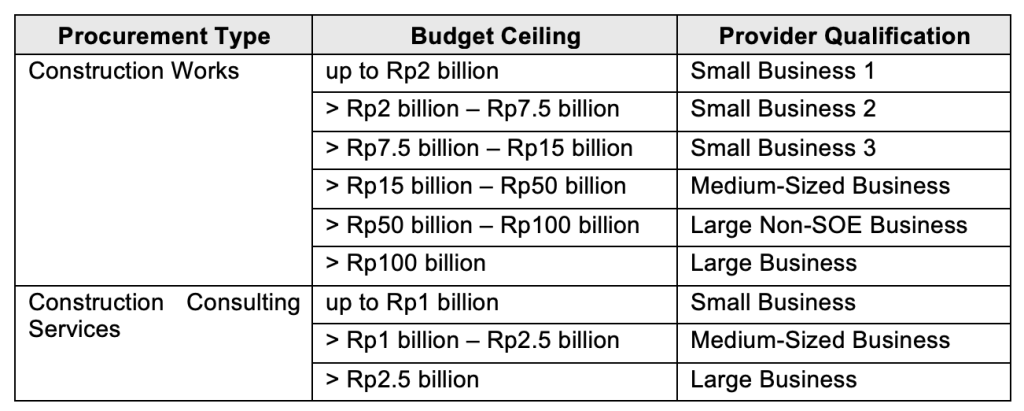
Under LKPP Regulation 3/2026, construction service businesses are classified based on the budget ceiling and the providers’ qualifications or subqualifications. The applicable classifications are set out in the table below.
Prohibitions for Procurement Parties
A new set of prohibitions in LKPP Regulation 3/2026 applies to all parties involved in procurement through providers, including:
- lending or using another company’s name; and/or
- transferring all work and responsibilities to another party.
Partial transfer of work to another party is permitted, provided that it complies with the applicable laws and regulations.
What Should Companies Consider After These Changes?
LKPP Regulation 3/2026 entered into force on 22 September 2026. However, based on LKPP Circular Letter No. 3 of 2026 on the Implementation of LKPP Regulation 3/2026, procurement processes conducted under LKPP Regulation 12/2021 between 22 September and 9 October 2026 may continue under the previous regulation until the contracts expire. For certain processes carried out after 9 October but before 29 October 2026, the relevant government authority may decide to continue the process under the previous regulation or cancel and restart it under LKPP Regulation 3/2026, subject to the applicable conditions. In addition, any contracts signed based on LKPP Regulation 12/2021 remain valid until the expiry of the respective contracts.
For companies planning to participate in government procurement, the applicable requirements depend on the procurement process and the stage it has reached. Companies should therefore consider the following points before participating:
- identify the applicable method and check whether e-purchasing is mandatory for the relevant goods or services;
- review pricing and contract values against the applicable HPS thresholds and repeat order requirements;
- prepare for electronic procurement procedures by understanding the transactional or recording features applicable to the procurement process;
- ensure that the products offered comply with the applicable domestic product requirements;
- confirm construction business qualifications against the budget ceiling of the relevant project; and
- comply with the applicable prohibitions to avoid non-compliance.
By preparing for these changes, companies can better assess their eligibility and meet the applicable requirements when participating in government procurement. Should you require further information or assistance in navigating the requirements under LKPP Regulation 3/2026, please feel free to contact our team.
Disclaimer
This publication is prepared by Clavis Law Firm for general informational purposes only and does not constitute legal advice. It is intended to provide a high-level overview of the relevant legal and regulatory developments as of the date of publication and should not be relied upon as a substitute for specific legal advice.