
MINIMUM REQUIREMENTS FOR EPC CONTRACT IN INDONESIA

Daniel Tampi
Managing Partner
daniel.tampi@clavislawfirm.id

Oliviani Yanto
Associate
oliviani.yanto@clavislawfirm.id
If you are planning or undertaking a construction project, you need more than a project plan. You need a clear contractual framework to guide the project from the first design on paper to the final handover — and this is where an Engineering, Procurement, and Construction (“EPC”) Contract comes in.
In Indonesia, EPC Contracts are governed by:
- Law No. 2 of 2017 on Construction Services, as last amended by Law No. 6 of 2023 on the Stipulation of Government Regulation in Lieu of Law No. 2 of 2022 on Job Creation as Law (“Construction Services Law”); and
- Government Regulation No. 22 of 2020 on the Implementing Regulation of Construction Services Law, as amended by Government Regulation No. 14 of 2021.
This article highlights the minimum requirements that should be addressed in an EPC Contract under Indonesian regulations.
What Is an EPC Contract and Who Is Involved?
An EPC Contract brings three (3) key parts of a construction project—engineering, procurement, and construction—into one integrated contract. Instead of having separate arrangements for each stage, the work is carried out under one overall contractual framework.
These stages are closely connected and affect each other throughout the project. Therefore, an EPC Contract combines these stages under one contract rather than separate contracts. Having one contract covering the entire project gives the parties a common framework for managing and coordinating the different stages. This gives the owner greater clarity on the contractor’s responsibilities and allows the contractor to manage the different stages under one clear scope of work.
There are two (2) main parties in an EPC Contract: the owner and the contractor.
The owner refers to the person or entity that owns the project or engages the construction services. The contractor, on the other hand, is responsible for providing the construction services and carrying out the agreed scope of work. Both the owner and the contractor can be individuals or business entities. In practice, EPC projects are more commonly carried out by business entities, given the scale and nature of the work involved.
What Are the Minimum Contents of an EPC Contract?
An EPC Contract should set out the terms that guide the project from start to finish. This includes the scope of work, the responsibilities of each party, payment arrangements, and how potential issues during the project will be handled.
At a minimum, an EPC Contract should address the following matters:
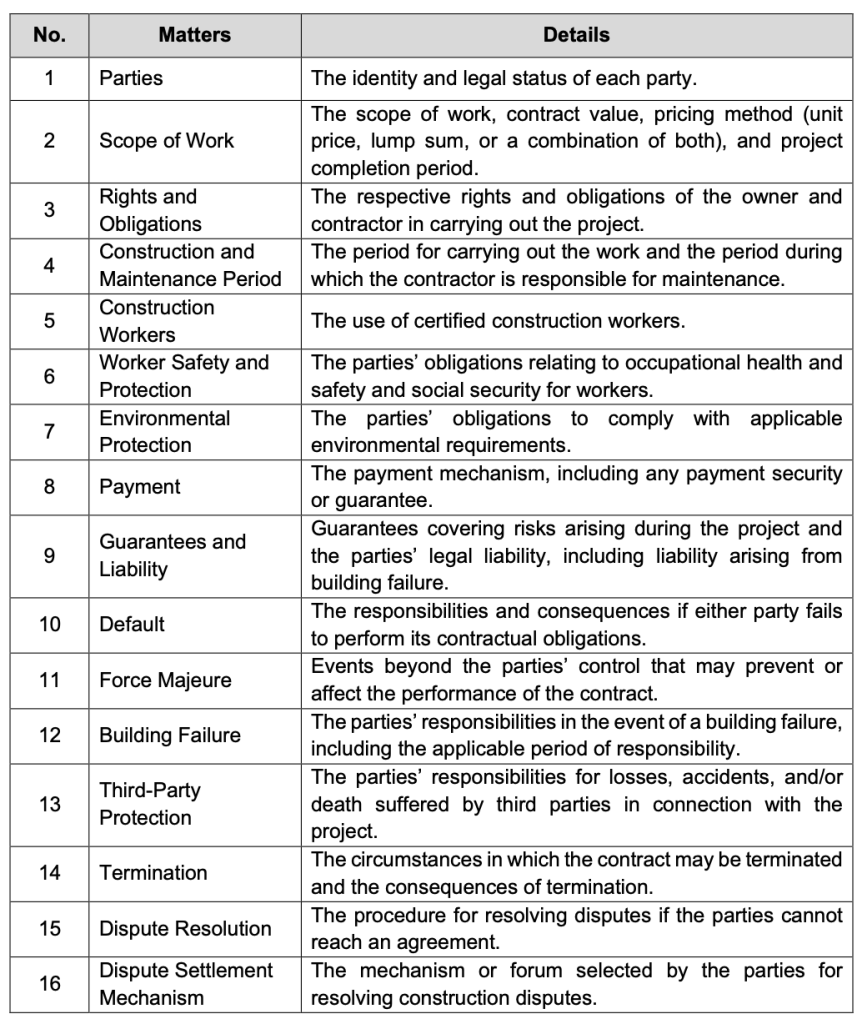
What Documents Form Part of an EPC Contract?
The contractual framework for an EPC project consists of several documents. These documents set out the terms, requirements, and responsibilities that apply throughout the project. Each document covers a specific purpose and forms part of the overall contractual arrangement.
The following documents should form part of the EPC Contract:
- Contract Agreement, which sets out the identity of the parties, recitals, scope of work, principal terms of the contract, and the list of documents, including their order of precedence to determine which document will apply in case of any inconsistency;
- Particular Conditions of Contract, which set out project-specific provisions, including the time for completion and maintenance period, payment terms, guarantees, price adjustment, liquidated damages, occupational health and safety, and taking-over of the works;
- General Conditions of Contract, which set out the general provisions governing the performance of the works, including the scope of work, payment, measurement of work, the rights and obligations of the parties, personnel and equipment, quality control, variations, termination, and dispute resolution;
- Owner’s Documents, which include specifications, drawings, and the bill of quantities and prices that form the basis of the contractor’s tender;
- Contractor’s Proposal, which sets out the proposed method of execution, tender price, work schedule, and resources to be used for the project;
- Minutes of Clarification, which record the agreements reached during the tender evaluation process;
- Letter of Acceptance, is a letter from the owner confirming its acceptance of the contractor’s tender; and
- Contractor’s Undertaking, is a written commitment from the contractor to perform the works in accordance with the contract.
What Language Should an EPC Contract Use?
An EPC Contract must be made in Indonesian. If the contract involves a foreign party, it must also be made in English. Accordingly, the contract should be prepared in both Indonesian and English. In the event of a dispute involving a foreign party, the Indonesian version will prevail over the English version.
For businesses involved in EPC projects in Indonesia, understanding these requirements helps ensure that the key aspects of an EPC Contract are properly addresse d from the outset. A clear contractual framework supports the smooth implementation of the project and the proper allocation of responsibilities.
Should you have any questions or require assistance with reviewing or preparing an EPC Contract, please feel free to contact our team.
Disclaimer
This publication is prepared by Clavis Law Firm for general informational purposes only and does not constitute legal advice. It is intended to provide a high-level overview of the relevant legal and regulatory developments as of the date of publication and should not be relied upon as a substitute for specific legal advice.