
BEYOND SIGNING: RECORDING LICENSE AGREEMENTS IN INDONESIA

Daniel Tampi
Managing Partner
daniel.tampi@clavislawfirm.id

Oliviani Yanto
Associate
oliviani.yanto@clavislawfirm.id
You have a license agreement. Is signing it enough to protect your rights? A signed agreement sets out the rights and obligations between the parties, but in Indonesia, signing a license agreement is not necessarily the final step.
Businesses are required to record their license agreements with the Ministry through the Directorate General of Intellectual Property (Direktorat Jenderal Kekayaan Intelektual or “DJKI”). Recording the agreement can help protect the rights granted under the license, particularly when third parties become involved. It can also help businesses avoid potential legal risks that may arise if the agreement is not properly recorded.
The following are key points businesses should know about recording license agreements in Indonesia.
What Is a License Agreement?
A license agreement is an agreement that allows the owner of intellectual property (“IP”) to give another party permission to use or commercialize the IP under agreed terms and conditions. The license can be exclusive or non-exclusive. An exclusive license gives one licensee the sole right to use or commercialize the IP within the agreed scope, while a non-exclusive license allows the IP owner to grant the same rights to other parties. Regardless of the type of license, ownership of the IP remains with the IP owner.
There are two main parties involved: (i) the licensor, who grants the license; (ii) the licensee, who receives the rights to use the IP. The agreement sets out, among other things, the scope of the rights granted, the permitted use of the IP, and the duration of the license. Under Government Regulation Number 36 of 2018 on Intellectual Property License Agreements, a license agreement must at least include the following information:
- the date and place of signing;
- the names and addresses of the licensor and licensee;
- the IP covered by the license;
- whether the license is exclusive or non-exclusive and whether sublicensing is allowed;
- the duration of the license;
- the territory where the license applies; and
- for patent licenses, which party is responsible for paying the annual patent fee.
What Can Be Recorded and Who Can Apply?
License agreements covering various types of intellectual property can be recorded, including copyright and related rights, patents, trademarks, industrial designs, layout design of integrated circuits, trade secrets, and plant varieties.
The application can be submitted by the licensor, the licensee, or their authorized representative. If the licensor or licensee is a foreign national or is domiciled or permanently established outside Indonesia, the application must be submitted through an authorized representative.
Can a License Agreement Cover Multiple Intellectual Property Rights?
A single license agreement can cover multiple intellectual property rights. This allows the parties to include different IP rights in one agreement where they are part of the same licensing arrangement.
However, the recording application may need to be submitted separately depending on the types of intellectual property covered. For copyright or related rights, one application can cover multiple works or titles involving the same type of intellectual property.
What Documents Are Required?
The applicant must provide the following documents to record the license agreement:
- application letter for recording the license agreement;
- the license agreement;
- official extract or proof of ownership of the licensed IP, such as a patent, trademark, industrial design, or integrated circuit layout design certificate, or proof of ownership of copyright, related rights, or trade secrets. The relevant IP rights must still be valid;
- power of attorney, if the application is submitted through an authorized representative; and
- proof of payment of the applicable recording fee.
How Does the Recording Process Work?
The recording process generally involves the following steps.
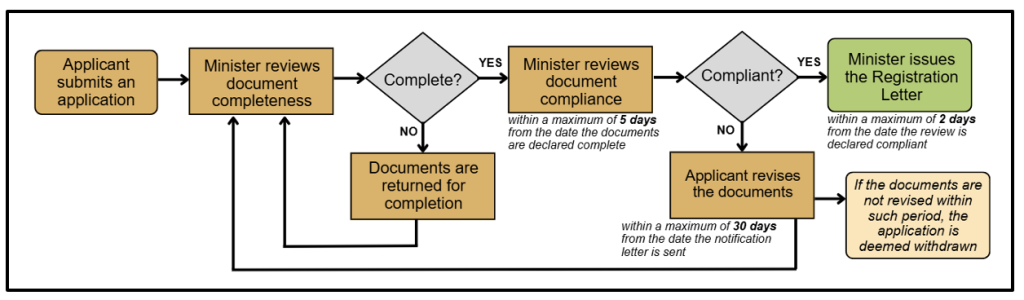
First, prepare the required documents. The applicant prepares the documents required for the recording application.
Second, submit the application. The application is submitted through the DJKI system for the relevant type of intellectual property.
Third, the documents are checked for completeness. If any documents are missing, the application is returned to the applicant for completion.
Fourth, the documents are reviewed for compliance. Once the documents are complete, the Minister reviews the documents for compliance with the applicable requirements within five (5) days. If the documents do not meet the requirements, the applicant is given up to thirty (30) days to make the necessary adjustments. If the applicant fails to make the necessary adjustments within this period, the application is deemed withdrawn and the fee paid cannot be refunded.
Finally, the recording certificate is issued. If the documents are complete and meet the requirements, the Minister issues a License Agreement Recording Certificate and notifies the applicant within two (2) days from the completion of the review.
The recording of a license agreement remains valid for as long as the license agreement is in effect. During this period, the license agreement may be amended subject to prior notification to the Minister and the payment of applicable fee. Once the license agreement expires, the applicant may submit a new application to record the license agreement.
What Happens If a License Agreement Is Not Recorded?
Recording a license agreement with DJKI is important because an unrecorded and unpublished license agreement does not have legal effect against third parties. However, the absence of recording does not automatically invalidate the agreement between the licensor and licensee. The agreement may therefore remain binding between the parties as long as it meets the requirements for a valid agreement.
The main consequence of not recording the agreement relates to its legal effect against third parties. While the license may remain binding between the licensor and licensee, the licensee may not be able to rely on the agreement or assert the rights granted under the license against a third party.
For this reason, recording a license agreement is not only a way to protect the licensee against the risk of the licensor failing to comply with the agreement. It can also help address potential third-party risks, particularly where another party later claims rights or an interest in the same intellectual property. Recording the agreement therefore gives the licensee greater protection by ensuring that the license can have legal effect beyond the relationship between the licensor and licensee.
A license agreement provides the foundation for the parties’ rights and obligations, while recording the agreement adds protection beyond the contractual relationship. Proper recording helps businesses protect the rights they have obtained under the license when dealing with other parties.
If you have any questions about recording license agreements or how recording can help protect your IP rights, please feel free to contact our team.
Disclaimer
This publication is prepared by Clavis Law Firm for general informational purposes only and does not constitute legal advice. It is intended to provide a high-level overview of the relevant legal and regulatory developments as of the date of publication and should not be relied upon as a substitute for specific legal advice.