
INDONESIA'S NEW FOOD PACKAGING REGULATIONS: UNDERSTANDING THE NEW REQUIREMENTS FOR REUSABLE AND RECYCLED PACKAGING

Daniel Tampi
Managing Partner
daniel.tampi@clavislawfirm.id

Oliviani Yanto
Associate
oliviani.yanto@clavislawfirm.id
What happens when the packaging of a product—whether it is a wrapper, container, or seal—becomes subject to new legal requirements? For companies that manufacture, import or use food packaging in Indonesia, this is increasingly becoming a concern as Indonesia undergoes a significant shift in its regulatory framework governing food packaging.
Indonesia has introduced a new regulatory framework for food packaging through the issuance of the Indonesian Food and Drug Authority (Badan Pengawas Obat dan Makanan or “BPOM”) Regulation Number 11 of 2026 on Food Packaging (“BPOM Regulation 11/2026”), revoking and replacing the previous BPOM Regulation Number 20 of 2019 on Food Packaging (“BPOM Regulation 20/2019”). The new regulation reflects the government’s continued efforts to strengthen food safety standards while supporting more sustainable packaging practices.
Overview of the Key Changes
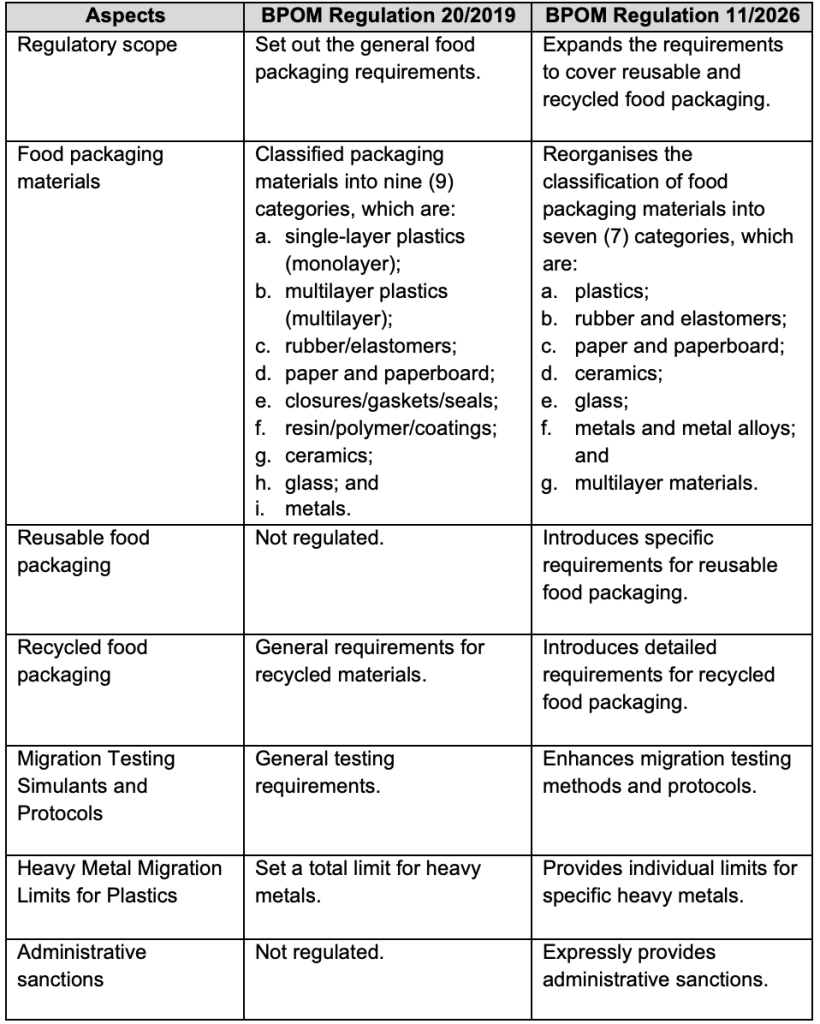
BPOM Regulation 11/2026 provides a number of notable changes to Indonesia’s food packaging regulatory framework. These changes affect not only reusable and recycled food packaging, but also broader safety and compliance requirements applicable to food packaging. The key changes are summarised in the table below:
What Are the New Requirements?
BPOM Regulation 11/2026 establishes more comprehensive requirements governing the safety and use of food packaging, with several key changes as outlined below:
- Reusable Food Packaging
Reusable food packaging refers to food packaging that is designed to be used more than once. To ensure that reusable packaging remains safe for repeated use, BPOM Regulation 11/2026 requires reusable food packaging to comply with the applicable migration limits, which prescribe the maximum permissible levels of substances that may migrate from the packaging into food. For reusable plastic food packaging, compliance with these limits must be demonstrated through migration testing.
- Recycled Food Packaging
Recycled food packaging refers to food packaging made from recycled packaging materials that have been reprocessed for reuse as food packaging. Although it is made from recycled materials, it must be manufactured in accordance with the applicable requirements and meet the same food safety standards as other food packaging materials. This includes compliance with the requirements on permitted food contact substances, material specifications, and restricted substances.
- Heavy Metal Migration Limits for Plastics
BPOM Regulation 11/2026 adopts a more granular approach to heavy metal migration limits in plastic food packaging. While the previous regulation prescribed a single overall limit for heavy metals, BPOM Regulation 11/2026 specifies individual migration limits for specific heavy metals in plastic food packaging. Under the new legal framework, arsenic, cadmium, total chromium, and mercury must not be detected above their respective detection limits, while lead is subject to a maximum migration limit of 0.05 mg/kg.
- Migration Testing Simulants and Protocols
Food packaging materials that come into direct contact with food must undergo migration testing to demonstrate compliance with the applicable migration limits. BPOM Regulation 11/2026 provides detailed testing methods and protocols, including the use of different food simulants and specific testing conditions based on the type of food and its intended conditions of use. These requirements are intended to ensure that migration testing accurately reflects actual food contact conditions.
- Food Contact
Food packaging that comes into direct contact with food must be made using safe food contact substances. BPOM Regulation 11/2026 prohibits the use of food contact substances that may release hazardous contaminants into food and pose a risk to human health. In addition, Annex IV of the BPOM Regulation 11/2026 lists 142 prohibited food contact substances that must not be used in food packaging.
If a food contact substance is not listed under BPOM Regulation 11/2026, it may only be used after obtaining prior approval from BPOM, which will be granted following a safety assessment. To obtain such approval, an application must be submitted together with supporting information and documents, including the applicant’s details, information on the food packaging material and/or food contact substance, and food packaging test results.
What Happens If the Company Fails to Comply?
A company that fails to comply with BPOM Regulation 11/2026 may be subject to administrative sanctions. While the regulation does not specify the types of sanctions, it refers to the relevant Indonesian food safety regulations. Based on Government Regulation Number 86 of 2019 on Food Safety, as amended by Government Regulation Number 1 of 2026, a company may be subject to the following administrative sanctions:
- fines;
- temporary suspension of business activities (including food production and/or food distribution);
- recall of food products from the market;
- indemnity payments; and/or
- revocation of business licences.
When Will the Regulation Take Effect and What Should Companies Do During the Transition Period?
BPOM Regulation 11/2026 will take effect on 1 July 2027, giving companies until 30 June 2027 to review their packaging materials, make any necessary adjustments, and ensure compliance with the updated regulatory framework. During this transition period, companies should consider:
- reviewing whether the food packaging materials comply with BPOM Regulation 11/2026;
- ensuring that reusable and recycled food packaging meets the applicable requirements;
- determining the applicable migration testing requirements and protocols under BPOM Regulation 11/2026;
- confirming that the food contact substances used are permitted under BPOM Regulation 11/2026; and
- identifying any food contact substances that require prior BPOM approval before use.
Companies are encouraged to use this transition period to ensure that their packaging materials and internal processes are aligned with the requirements of BPOM Regulation 11/2026 before it takes effect.
Navigating new regulatory requirements can be complex. Our team brings deep experience in Indonesia’s regulatory landscape to guide your business through these changes. Should you have any questions or queries, please feel free to contact our team.
Disclaimer
This publication is prepared by Clavis Law Firm for general informational purposes only and does not constitute legal advice. It is intended to provide a high-level overview of the relevant legal and regulatory developments as of the date of publication and should not be relied upon as a substitute for specific legal advice.